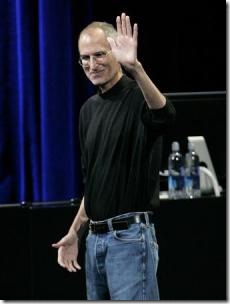
 Steve Jobs resigned as CEO of Apple Inc on Wednesday and passed the reins to his right-hand man Tim Cook, saying he could no longer fulfill the duties in a bombshell announcement that raised fears his health has deteriorated further.
Jobs, who fought and survived a rare form of pancreatic cancer and revolutionized the technology arena with the iPhone and the iPad in the past four years, is deemed the heart and soul of a company that this month briefly became the most valuable in America.
"I have always said if there ever came a day when I could no longer meet my duties and expectations as Apple's CEO, I would be the first to let you know. Unfortunately, that day has come," Jobs, who takes on the new position of chairman, said in a short letter announcing his resignation.
The letter and a separate terse, somewhat cryptic statement from Apple raised more questions than it answered about Jobs' health and the future of the company.
While it's unlikely that his departure as CEO will derail Apple's ambitious product-launch roadmap in the near term, there are concerns about whether the company would stay a creative force to be reckoned with beyond the next year or so without its founder and visionary at the helm.
That is why Apple's stock dropped as much as 7 percent in after-hours trading when Jobs' departure was announced.
In the company statement, Apple co-lead director Art Levinson on behalf of the board praised Jobs' "extraordinary vision and leadership" and "countless contributions to Apple's success", saying he would continue to serve the company with "unique insights, creativity and inspiration."
However, the statement, which also talked about Cook's outstanding performance, said nothing about Jobs' health.
His battle with pancreatic cancer, which has stretched over several years, has been of deep concern to Apple fans, investors and the company's board. Over the past two years, even board members have confided to friends their concern that Jobs, in his quest for privacy, wasn't being forthcoming with directors about the true condition of his health.
Jobs has been on medical leave since January 17, with his duties being filled by Cook, who was chief operating officer.
Jobs spent all Wednesday meeting with board members and top managers at Apple's headquarters at 1 Infinite Loop in Cupertino, and plans to remain active in his new role, a source close to Jobs told Reuters. A second source said Jobs will remain on the board of Walt Disney Co.
Still, some industry insiders express concern that Jobs' has clearly signaled he is too ill to keep up the punishing pace of a top executive job.
The 56-year-old Jobs had briefly emerged from medical leave in March to unveil the latest iPad and later attended a dinner hosted by President Barack Obama for technology leaders in Silicon Valley. But his often-gaunt appearance had sparked questions about how bad his illness was and his ability to continue at Apple.
In each of Jobs' three health-related absences, Cook has taken over the helm. But the 50-year-old Alabama native, a former Compaq executive and an acknowledged master of supply-chain management, remains largely untested in Wall Street's view.
That's partly why, despite Cook being viewed as a safe bet to run Apple's sprawling empire, some still think his boss will be very badly missed. One Silicon Valley CEO, who declined to be identified because of the sensitive issues involved, said the tone of Jobs' statement indicated his health might be worse than publicly known.
Jobs has earned a reputation for commanding every aspect of operations - from day-to-day running to broad strategic decisions - suggesting he would not have given up the job if he had a choice.
"It's really sad," the CEO told Reuters. "No one is looking at this as a business thing, but as a human thing. No one thinks that Steve is just stepping aside because he just doesn't want to be CEO of Apple anymore."
"It feels like another shoe is going to drop."
AGAIN, DEEP BENCH
Fans paid tribute but lamented his resignation, openly airing fears for the health of their technology guiding light. Employees at a downtown San Francisco Apple store huddled in small groups after the news spread through word of mouth.
"Not gonna lie - I teared up upon the #stevejobs news," said Bob Skrezyna, who goes by 'wordrebel' on Twitter.
Some reactions were put in crudely poetic, though somewhat poignant, terms. One Apple fan from Denmark posted on Facebook: "Good Job. I just ate an Apple. It was bittersweet. Guess I'll just have to Cook it from now on."
Others simply sympathized.
"It's sad to see someone visibly deteriorating and to see such a giant going through this. My heart goes out to his wife and kids," said Kelli Praught, an employee at a Palo Alto business who has served Jobs' wife.
The news caused immediate ripples in Asia, where many of the company's major suppliers and rivals are based. Samsung Electronics, Apple's top chip supplier and a major rival in smartphones and tablets, rose 3 percent in early trade, though part of that was because of a patent ruling in a court battle with Apple in the Netherlands. Sony Corp, which was overtaken by Apple in the personal music and tablet space, rose 1 percent.
While Jobs did not detail the state of his health, oncologists who have not treated the Apple founder said he could be facing several problems tied to his rare form of pancreatic cancer and subsequent liver transplant. They include possible hormone imbalances or a recurrence of cancer that is harder to fight once the body has already been weakened.
"I have to imagine that it's related to his health. I cannot imagine another explanation," said Jason Hirschhorn of The ReDEF Group, and the former CEO of MySpace.
His resignation certainly marked the end of an era at Apple.
A college dropout, a Buddhist and a son of adoptive parents, he started Apple Computer with friend Steve Wozniak in the late 1970s.
The company soon introduced the Apple 1 computer. But it was the Apple II that became a huge success and gave Apple its position as a critical player in the then-nascent PC industry, culminating in a 1980 IPO that made Jobs a multimillionaire.
Despite the subsequent success of the Mac, Jobs' relationship with internal management soured, and in 1985 the board removed most of his powers fired him.
Apple's fortunes waned after that. However, its purchase of NeXT -- the computer company Jobs founded after leaving Apple -- in 1997 brought him back into the fold. Later that year, he became interim CEO and in 2000, the company dropped "interim" from his title.
But it was the iPhone in 2007 that cemented his legacy in the annals of modern technology history. Two years before the gadget that forever transformed the way people around the world access and use the Internet, Jobs talked about how a sense of his mortality was a major driver behind that vision.
"Remembering that I'll be dead soon is the most important tool I've ever encountered to help me make the big choices in life," Jobs said during a Stanford commencement ceremony in 2005. "Because almost everything -- all external expectations, all pride, all fear of embarrassment or failure -- these things just fall away in the face of death, leaving only what is truly important."
"Remembering that you are going to die is the best way I know to avoid the trap of thinking you have something to lose. You are already naked. There is no reason not to follow your heart."
Google Inc Chairman Eric Schmidt, a friend of Jobs for years before the Internet search giant's move into mobile software and devices strained their relationship, wrote a moving testament to the legacy of his erstwhile business partner, echoing the responses of many of his fellow Silicon Valley executives on Wednesday.
"Steve Jobs is the most successful CEO in the U.S. of the last 25 years, "he said. "He uniquely combined an artist's touch and an engineer's vision to build an extraordinary company... One of the greatest American leaders in history."
Wall Street once again expressed confidence in the Apple bench, headed by supply-chain maven Cook.
"I will say to investors: don't panic and remain calm, it's the right thing to do. Steve will be chairman and Cook is CEO," said BGC Financial analyst Colin Gillis.
On Wednesday, Apple shares slid to $357.40 in extended trading after a brief halt. They had gained 0.7 percent to close at $376.18 on the Nasdaq.
"Investors are very comfortable with Tim Cook even though Jobs has been a driver of innovation and clearly an Apple success. Tim has shown Apple can still outperform extremely well when he's been acting as CEO," said Cross Research analyst Shannon Cross.
Apple previously did not have a chairman. The company had said it didn't need one, the structure worked best for shareholders, and that it preferred to rely on two independent co-lead directors.
In his letter of just eight short sentences that was addressed to the board and Apple community, Jobs said: "I hereby resign as CEO of Apple. I would like to serve, if the Board sees fit, as Chairman of the Board, director and Apple employee."
They did see fit.


